
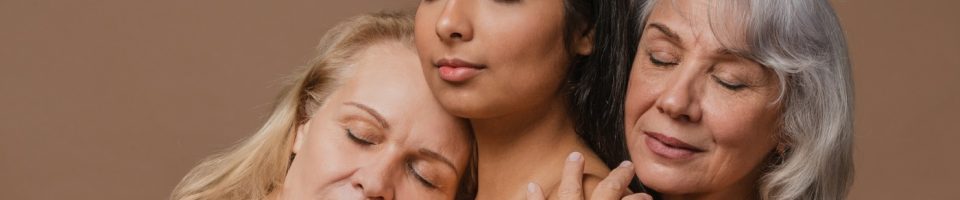
You’re Not Crazy… You’re Perimenopausal
What Your Body is Actually Telling You
You wake at 3am and lie there, mind already running. You feel like you’re constantly behind, constantly holding everything together, and yet somehow less able to hold it than you used to be. You’re tired in a way that sleep doesn’t fix. Your periods have changed. Your patience is shorter. Something feels different, and you can’t quite put your finger on what.
You might have been told your blood tests are normal. You might have been offered antidepressants, or sleeping tablets, or told it’s just stress.
But here’s what I want you to consider: you might be perimenopausal. And far from something being wrong with you, your body might be doing exactly what it’s supposed to do, asking you to pay attention.
It starts earlier than you think.
Perimenopause, the hormonal transition that precedes menopause can begin as early as the mid-30s, and typically starts in earnest in the early-to-mid 40s. It is not a sudden event but a gradual process, often spanning a decade, during which oestrogen and progesterone begin to fluctuate and eventually decline.
Progesterone tends to drop first, which is why sleep disruption and anxiety are often the earliest signs progesterone has a calming, GABA-promoting effect on the nervous system, and when it starts to wane, the nervous system notices. Oestrogen fluctuates erratically before it declines, which is why symptoms can feel unpredictable: some months fine, others impossible.
What this looks like clinically:
• Waking between 1–4am, often with a racing mind or low-grade anxiety
• Cycles becoming shorter, heavier, or more irregular
• PMS that is suddenly worse, more emotional, more physical
• Brain fog, difficulty concentrating, word-finding problems
• Joint pain and muscle tension, particularly around the neck and shoulders
• Increased sensitivity to stress, less resilience, longer recovery
• Skin and hair changes
A low but persistent sense that something needs to shift
None of these are minor. And none of them are inevitable, there is a great deal that naturopathic medicine and acupuncture can do to support this transition. But first, I want to offer you a different lens for understanding what is happening.
What TCM tells us about this transition.
In Traditional Chinese Medicine, the hormonal transition of perimenopause is understood through the lens of Kidney Jing, the deep constitutional essence we are born with and draw upon throughout our lives. Jing governs our reproductive capacity, our vitality, and our ageing process. It is finite, and it is precious.
The Kidney system in TCM also houses our Yin, the cooling, nourishing, restorative aspect of our physiology. When Kidney Yin begins to decline, as it naturally does in the perimenopausal years, we see heat signs: night sweats, hot flushes, the restless 3am waking, the nervous system running hot.
Kidney Yang the warming, activating force also shifts during this time, which explains the fatigue, the cold hands and feet, the flagging motivation that can accompany what looks on the surface like a purely “hot” picture.
The Liver, which governs the smooth flow of Qi and Blood and is intimately tied to hormonal regulation, becomes easily disturbed when Kidney Yin is insufficient to anchor it, hence the irritability, the anxiety, the emotional volatility that many women experience.
This is not pathology. It is a system under pressure, asking to be tended to.
The resource question: what have you spent, and what do you have left?
Last year I attended a seminar with Yvonne Farrell, an American acupuncturist and one of the most gifted TCM teachers I’ve encountered in the field of women’s health. What she said reframed perimenopause for me in a way I hadn’t heard before, despite having studied and practised in this space for over two decades.
Yvonne described perimenopause as the moment when a woman’s resources come up for review. Not as punishment, but as reckoning. Have you overused your resources your time, your energy, your Qi and Blood and Jing across your reproductive years? Have you given more than you’ve restored? Have you deferred your own needs, consistently, in service of everything and everyone else?
If you have and most women in midlife have, to some degree perimenopause is pay-up time. The body’s capacity to compensate, to keep going, to absorb stress and override depletion, begins to diminish. What was manageable before becomes unmanageable. What was pushed aside comes forward.
“Perimenopause is not the beginning of the end. It is the body’s invitation to stop living on borrowed resources and begin living from a place of genuine replenishment.”
The archetypes: Maiden, Mother, and the Crone.
There is an older framework for understanding a woman’s life arc one that predates medicine and sits in mythology and archetype. It maps the stages of a woman’s life onto three figures: the Maiden, the Mother, and the Crone.
The Maiden is the years of becoming of curiosity, formation, fertility in its broadest sense.
The Mother is the years of creation and nurturing and this archetype extends far beyond literal motherhood. It includes careers built, businesses grown, communities held, causes served. Any endeavour you pour yourself into and bring into being is mothered. Many women spend decades in this archetype, giving enormously, building beautifully and deferring themselves.
The Crone is the third phase and it is worth pausing here, because the word itself carries a history worth naming. Linguistically, “crone” has not been a kind word. It has been used for centuries to diminish older women, to render them invisible, to suggest that a woman past her reproductive years has passed her usefulness. That framing tells us more about the culture that produced it than it does about the women it described.
What many modern women’s health practitioners, psychologists, and feminist thinkers are doing is reclaiming the Crone as an archetype of wisdom, sovereignty, and leadership, not by pretending the word was always positive, but by deliberately refusing the diminishment it was meant to carry. It is a conscious act of crowning yourself. Of saying: this phase of my life is not a decline. It is a graduation.
The Crone, in this reclaimed sense, is the woman who has moved through the fertile years, metabolised her experience, and now stands as an elder a guide, a sovereign, a woman whose power no longer depends on external approval or biological function. She leads from depth, not performance.
Perimenopause is the threshold between the Mother and the Crone. It is the initiation into that next self.
And initiations, by their nature, are not comfortable.
Latency: what gets stored, and when it surfaces.
Here is something I see in clinic, over and over. During the mothering years, whether that’s raising children, building a business, caring for ageing parents, managing a demanding career, there is often simply not enough time or resource to deal with everything that arises. Grief that doesn’t get fully grieved. Resentments that don’t get resolved. Old wounds that get noted and set aside. Transitions that don’t get properly marked.
These things don’t disappear. In TCM terms, unresolved emotion and experience can become lodged in the Liver, in the Lungs, in the tissues, in the blood of the body. They go into a kind of latency, held in place by the sheer momentum and demand of a full life.
Perimenopause, as resources begin to shift, is when that latency lifts. Old things surface. Emotional material that seemed resolved or that was never properly processed, reappears.
Women describe feeling things they don’t quite understand, or recognising patterns they thought they’d moved past.
This is not regression. This is the body’s intelligence, offering a second chance at completion.
The women who move through perimenopause most gracefully, in my clinical experience, are the ones who are willing to meet what surfaces. To grieve what needs grieving, to change what needs changing, to let go of what is no longer theirs to carry. The ones who resist who try to push through, suppress, keep going as they always have, override the body’s signals tend to have the hardest time.
From AC/DC to pure DC: the power that awaits.
Yvonne offered another image that stayed with me. During the reproductive years, she described a woman’s energy as alternating current cyclical, rhythmic, moving between different hormonal and energetic states with each month. There is a particular kind of power in that cyclicality, but it is also a power with a pattern, a rhythm that the body must maintain.
After menopause, when that cycle completes, the energy available to a woman becomes direct current constant, unwavering, no longer subject to the monthly ebb and flow. Potentially unlimited.
But, and this is the critical part, that power is available only to the woman who has done the work of the transition. Who has let herself be initiated, rather than bypassed. Who has honoured herself enough to step into the Crone, to crown herself, rather than simply becoming a depleted version of the Mother she used to be.
This is what guides my work with women in perimenopause. Not just managing symptoms, though we absolutely work on that but supporting the whole arc of what this transition is asking.
What you can do now.
If you are in your late 30s or 40s and recognising yourself in any of this, there is a great deal that can be done both to ease the symptomatic picture and to support the deeper work of the transition.
From a naturopathic perspective, this might include herbal and nutritional support for hormonal regulation, adrenal and nervous system support (because exhausted adrenals make everything worse), targeted work on sleep, and addressing any underlying inflammatory or metabolic drivers.
From an acupuncture perspective, we work directly with the Kidney, Liver and Heart systems, nourishing Yin, anchoring Yang, smoothing the flow of Qi and Blood, and supporting the nervous system’s capacity to regulate.
And sometimes the work is simply this: being witnessed. Having a practitioner who understands what this transition actually is, who can help you see what your body is asking of you, and who holds the bigger picture when you’re too tired to hold it yourself.
If this resonates, I would love to work with you. You can book a Shine Spotlight call to see if working with me is a fit at www.shinehealthwellbeing.com.au, or reach us at the clinic on 03 9589 4549.
This is some of the most meaningful work I do. And you deserve to move through this with support.
With care,
Marta Dunin-Labedzki Naturopath and Acupuncturist
Helping you Shine from Inside out




Leave a Comment